
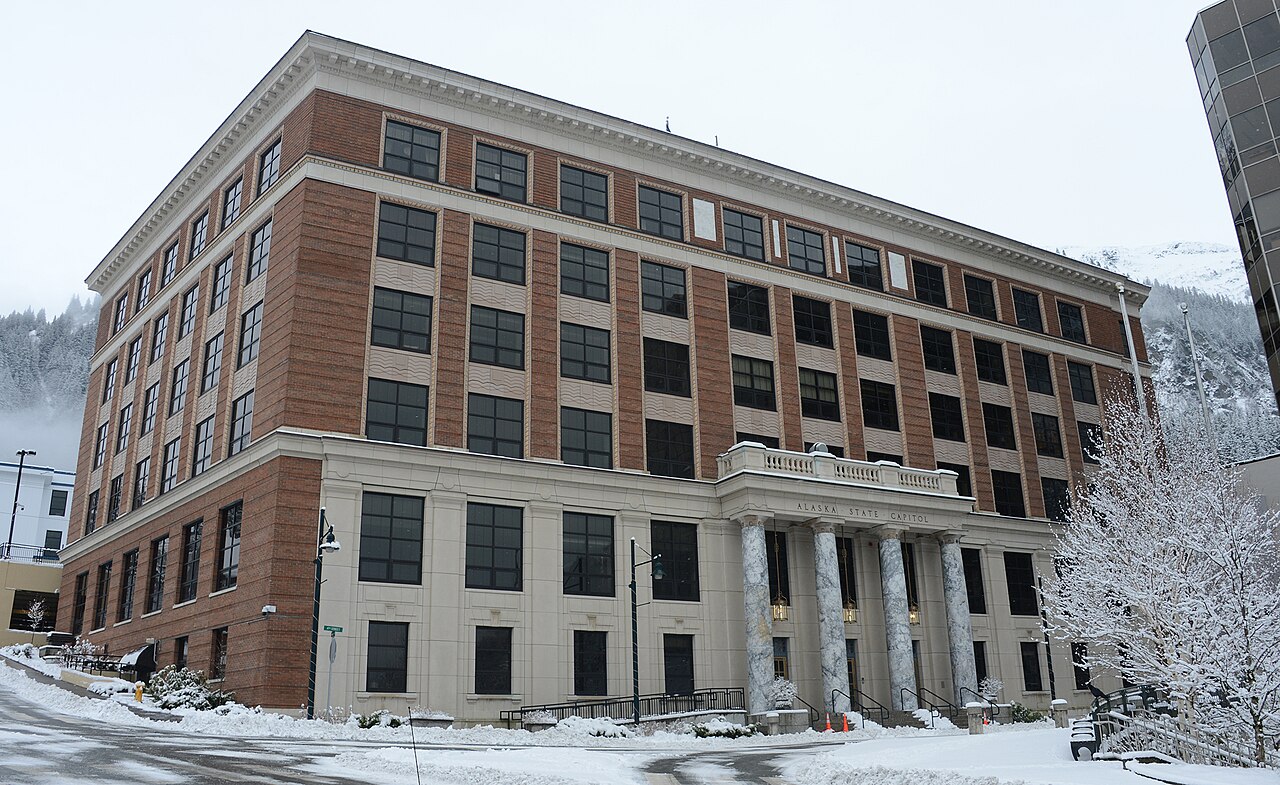
Democrat Jonathan Kreiss-Tomkins has won the race for governor of Alaska, according to projections by the Associated Press and NBC News, making him the state’s first Democratic governor since 2002. The AP called the contest on Friday evening local time, more than a week after voters went to the polls on November 3.
Kreiss-Tomkins, a 37-year-old former state representative from Sitka, took a little over half of the first-choice votes in a four-way race against three Republicans. That majority means Alaska’s ranked-choice system will not need extra rounds of counting to decide the winner. He will succeed Republican Gov. Mike Dunleavy, who is term-limited after holding the office since 2018.
The story in 7 points
- The AP and NBC News project Democrat Jonathan Kreiss-Tomkins as the winner of Alaska’s governor’s race.
- He received about 50.8% of first-choice votes, according to Newsweek’s tally of the results.
- Republican Bernadette Wilson, who was endorsed by President Trump, finished second with about 28.1%.
- Republicans Dave Bronson (about 13.6%) and Treg Taylor (about 7.7%) split the rest of the vote.
- Because he cleared 50%, no ranked-choice tabulation rounds are needed.
- He replaces term-limited Republican Gov. Mike Dunleavy, in office since 2018.
- He becomes Alaska’s first Democratic governor since 2002.
Kreiss-Tomkins was born in Sitka and represented a Southeast Alaska island district, including Sitka, Hoonah, Petersburg and Craig, in the state House from 2013 to 2023. He first won that seat in 2012 by just 32 votes after a recount, having left Yale University to run. During his time in the Legislature he sponsored a 2014 law that recognized 20 Alaska Native languages as official state languages.
He launched his campaign for governor in February and finished first in a crowded nonpartisan August primary, ahead of fellow Democrat Tom Begich. Under Alaska’s system, the top four primary finishers advance to the general election regardless of party. Begich, who also advanced, suspended his campaign in late August and endorsed Kreiss-Tomkins, arguing that two Democrats competing for the same donors would weaken the party’s chances. Republican U.S. Sen. Lisa Murkowski also backed Kreiss-Tomkins, who led in pre-election polling.
On the Republican side, the vote was divided among three candidates. Trump had endorsed Wilson and criticized Bronson and Taylor for staying in the race, accusing them of splitting the Republican vote. Early counts on election night showed Kreiss-Tomkins just under the 50% line, and his share edged upward as the remaining ballots were counted over the following days.
Why it matters
Alaska has leaned Republican in recent statewide races, and the result ends a run of more than two decades without a Democrat in the governor’s office; the last non-Republican was independent Bill Walker, who served from 2014 to 2018. During the campaign, Kreiss-Tomkins focused on school funding, retirement benefits for teachers and public employees, and the cost of living, including housing, energy and childcare. The win comes alongside other Democratic gains in the November 3 midterms, and it shows how ranked-choice voting and a divided field can shape results in the state.
What happens next: the AP projection is not the final word. Election officials still have to finish counting and certify the results, and Kreiss-Tomkins will then begin preparing a transition ahead of taking office from Dunleavy.
Sources: Newsweek, USA Today, Alaska Public Media